
ESSAY
Persona 4: a case of a successsful Japansese-RPG
How the first critically acclaimed entry of the series started a cult, before the series go mainstream
Introduction
Globalization has always somehow related to “Americanization” as how American corporations have been doing well with merchandising and franchising their products and make it goes worldwide. The basic example of this would be how wildly popular are American popular products. However, it doesn’t mean that there is an unbalance in globalization in the world (Consalvo, 2006). While the West (United States, UK, Europe) is certainly well known for its pop product, so is the East. The rise of Korean Wave, a manifestation helps describing everything pop culture that comes from South Korea, recently makes it heard clear to the world.
Yet, it was the Japanese Pop Culture that was started first, and made the first presentation for the East. Like Korean Wave, Japanese Pop Culture is also considered as ‘hybridity’ pop culture product. ‘Hybrid’ is a term that traditionally has been associated with post-colonial theory and notions of identity, regarding individuals or groups of individuals. It is the melding between business and culture, a convergence between two identities of two nations. Hybrid makes product convergence (Consalvo, 2006). Thus, it is unsurprised that it has ability to create cash flow globally, making it an incentive for many pop culture producers.
In 2010, METI founded the Creative Industries Promotion Office in an effort to bringing in the public and private funding to promote Cool Japan brand. The Cool Japan tag summarizes the all kinds of manifestations of Japanese popular products, from manga, anime, and video games to gastronomy, fashion and architecture and definitely J-Pop. Cool Japan’s mission is played as the vanguard of the international relations and economic recovery. This move has created a mechanism for those who already follows Japan’s soft power ‘meccas’ in Japan, while also promoting consumption of Japanese Pop product (Navarro-Remesal & Antonio Loriguillo-López 2015)
However, whenever talking about pop culture, films, J-Pop, anime and manga are usually what defines Japanese popular culture. Gemu, or Video Games in Japan, on the other hand, doesn’t have much attentions as other products. Nonetheless, Japanese video games also resembles similar traits like other pop products like manga and anime, regardless of being different medium. It’s called mukokuseki (Navarro-Remesal & Antonio Loriguillo-López 2015). Mukokuseki is a Japanese term that describes the representation, specifically visually, has been made through Japanese pop culture products. It is a motto, a state of no such identities, or an absence of cultural marks that relating to Japanese’s national identity (Self-Orientalism) This is why science-fiction genre gets to associate with Anime culture like the like of Ghost In The Shell. It creates the sense of ‘transnationalism’ that gets people easily associate with.
On the other hand, there are appearances that despite of the Mukokuseki’s representation, the ‘Japaneseness’ is strongly highlighted and make it as the selling point. For example, the Yakuza video game series is famous for its mini-games within the game are filled with cultures, the ‘Japaneseness’. Or several other examples like Naruto manga has some aesthetic that somehow resembles the ‘Japaneseness’. Nonetheless, this mixture of Mukokuseki is a unique trait that Cool Japan aware of, and thus, they also try to embrace it. This has created an expressional called ‘Self-Orientalism’ (Iwabuchi 2002).
However, it is a misconception that Cool Japan takes granted on products like the Yakuza series or Naruto series, the ‘Self-Orientalism’, the ‘Japaneseness’ within the traits of Mukokuseki for just purely economics purpose. In fact, they have learned that the global audiences appreciate the “Japaneseness” that represents in Mukokuseki, although the reason that Japanese pop product producers, in this case are Japanese game developers, keep the “Japaneseness” within their product is because they target Japanese audiences first, not the other way around. Thus, while the global audiences do have basic understanding the overall content of the game, there are large portions of the game that global audiences are clueless about, since it is strongly rooted from Japanese culture. And to me that represents Mukokuseki the best: It is universal because of its mentality. The rest of its representation is strongly inherited Japanese culture.
ABOUT
the PERSONA series
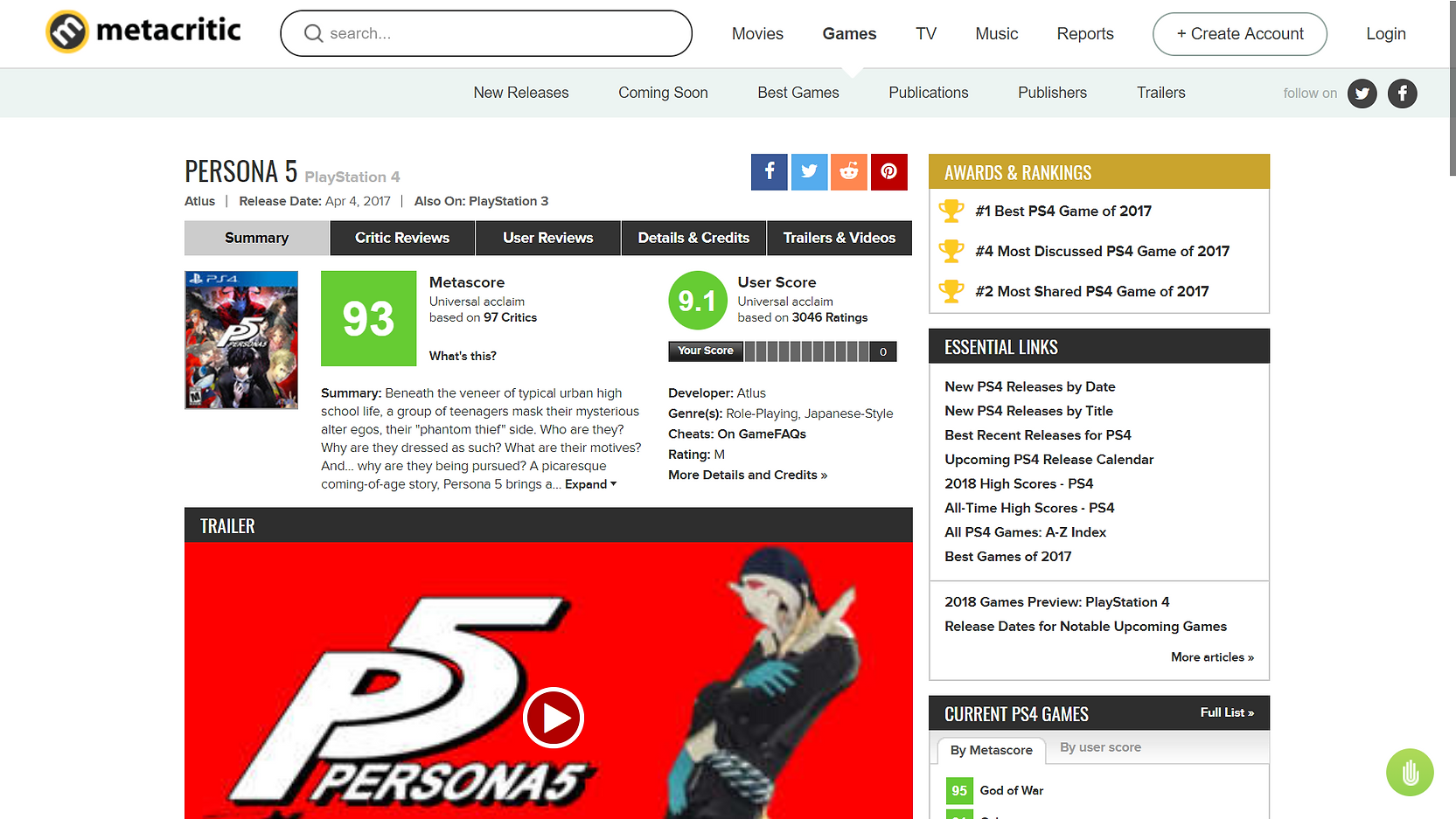
With the recent release of Persona 5, the game has achieved as one of the best high score reviews rating of a Japanese RPG since the release of Final Fantasy XI in 2000. The game has scored a 93% rating on Metacritic, a website that calculate the median average of all the scores of all the review websites. And to many developers, achieving about even above 80 is already a true achievement for their games. Persona 5 manage to be even better, and it has catapulted the entire franchise to a whole new level. However, Persona series has always been a cult, not as mainstream as the latest installment of the series.
The story of Yukiko Amagi

Meet Yukiko Amagi. Yukiko Amagi is a character of Persona 4. Yukiko Amagi is a rich girl who is perceived within the game as elegant young women who is popular with the boys and girls alike in school. That’s because she truly appreciates and cares about her friends, as well as her parents. She takes care of the family and staff from the Inn, a hot spring inn, her family business as it helps the rural town earn money. However, everything goes off rail as she disappears from school. She is also appeared full of struggles and pressure as she soon becomes the manager of the Inn, but as such a young age.
During midnight, the Midnight Channel starts to broadcast a show called “Princess Yukiko’s Search for Princess Charming” with a strange and bizarre Yukiko that very different from the usual Yukiko. Yet, the ‘Princess Yukiko’ is the Shadow Yukiko. While her friends try to look for Yukiko, they also witness Yukiko denies her shadow as the shadow assaults and vulgar towards her family and the Inn.
The shadow comes from Yukiko’s anxiety and frustration towards a predetermined life that she has, a life that have no choices and options that Yukiko is going through, because of the attachment with her family, and the spring garden business. This makes the Shadow Yukiko transforms into a giant monster, a red bird monster has Yukiko’s face and hair, sitting in a cage with ability to summon minions of shadows that look like a jack of card. They are portrayal of her entrapment feeling from the commitment with her family business and a strong desire to escape from this pressure.

Katsura Hashino, the creator of the series is aware of the concept of Jungian psychology. The Jungian psychology shows that if a person learns to accept the facets of their unconscious mind, they would elevate themselves and their unconscious mind. Hashino understands the appeal of the series and argues that the game series is not only for playing, but is also a sort of escapism. The core of the series has been about an appearance of the alternate world. In many ways, it can be described as the shadow of human society. According to Hashino, these alternate worlds serve as “an imaginative tool to express that lurk within our society”. They are represented as what we usually consider as ‘weakness’, and that people unconsciously possess that inhibit their individuation. There are a very few surrealism Japanese fantasy RPG that address the real-world experiences just like the Persona series. However, Hashino finds that the high school setting certainly make impact on Japanese people daily lives, simply because everybody have experienced this. (Kotzer, 2016) This is what makes Mukokuseki. It is sort of a mentality of a representation that appeal to everybody universally, that everybody can relate to.
The Effectiveness of Mukokuseki’s mentality - How Persona would win your heart
It’s mentality because it is more of an idea, an overall representation of these manifestation. In this case, the use of Jungian psychology for the series, that Katsura Hashino gets the idea from, is effective, as he wants to convey the message to anybody that consume the product. I have a conversation with a friend of mine, his name is T, who spends most of his time playing video games, during the teenager time. While he and I shows our love to the series, he adores the series more than I do. One of the game mechanic that forms the genre of the game was giving the players to have choices to do things, which forms its genre: a life simulation game.
The game provides you a role of a ‘semi defined avatar’, and in Persona 4, the character named Yu. The ‘avatar’ just only has basic portrayal such as gender, physical appearance and the character’s general ideology that later be implemented in the dialogue choices. While the dialogue options are limited, it still manages to give players to be themselves.
My friend, T, takes the game like his second life. Before the game happens, T sees himself as just one of those non-playable characters in video games, in the background. When he looked back, he considered himself a sore loser because he only plays World of Warcraft in his house, instead of going out with his friends. However, in Persona 4, Yu goes to school, takes exam, playing ball with their friends and dating. For T, my friend, these are wishful thinking. He told himself, while he was still in early in the game that, if only the appeared to him sooner, then he would have a perfect teenager life, just like Yu in Persona.
However, later, he learns something more meaningful when he starts to ‘date’ with Yukiko in the game. When the player confronts with Shadow Yukiko and her appearance on Midnight Channel, on a show called “Princess Yukiko Search for Prince Charming”, “Prince Charming” is not something actually Shadow Yukiko searches for. “Prince Charming” is an analogy of her waiting for something to free her from her predetermined life.
And T told me: “It is funny that I date this character Yukiko, but end up resembles a better life lesson. She is also sort of an introverted like me and find herself stuck, frozen. Yet, after I finished her character’s arc, she still wants to be the manager of her family business. But this time is different, she is content and happy.” He continues “I thought about whether the game could be arrived sooner or later in my life, but I don’t think that would change. But, what Yukiko does teach me though, is that I have choices in life.” After a talk with T, I realize there is a similar theme that run well in these Japanese popular products. Whether it is manga like Naruto or video games like the Persona series, they all have a fundamental mindset, that is to appeal, and to be easily understood to everybody.
Motifs - The Japaneseness within Mukokuseki
Besides from having a universal theme that shows Mukokuseki as a mentality, that is the only thing that global audiences can understand. The rest of Mukokuseki is constructed, strongly inherited with Japanese culture. This makes global audiences instantly recognizes the “Japaneseness” within Mukokuseki representation of Japanese popular product, yet they are unable to understand the meaning behind it. They are motifs (Cools, 2014).
The motifs within the Persona series is scattered around the game. It is together that they constructively build and become the universal theme. Yet, if they were standing on their own, each of them has different, their own unique meaning and different background to it. For example, the consistency of red color on portrayal of Yukiko Amagi. The monster and the ‘Persona’ when Yukiko could summon also sort of follow suits. Yukiko’s Persona is called Konohana Sakuya and it is based on a Japanese Legend. Konohana is a daughter of a mountain god, Ouyamatsumi. When she grew pregnant in the first night of her marriage, her husband accused her of infidelity. She stood in a burning hut, claiming that the fire would not touch her if she wasn’t faithful to her husband. This background story sort of goes hand in hand with Yukiko’s personality traits: an introverted girl with such caring yet a strong and determined willpower that anybody could depend on.
Because of the game has root of Japanese dating simulation and anime influences, there are humor and plot situations that regardless of the seriousness of the theme, there are always that contrary that usually have from Japanese pop culture product that find its hardly mistaken on any other popular culture product. Persona 4 is a game about the mystery murder, yet the introduction of the game projects pure joy to the players (Persona 4 Golden – Shadow World)
While the theme is varied in the series, how they interpret is also different, compared between the series. Persona 3 main motif is a handgun. When the game was released, the game quietly causes controversies, especially at the Western market, because of an image of a character points a gun at themselves. The game’s theme revolves around the proximity of death and

existential crisis, meaning of life (Harper, 2011). With the high suicide rate in Japan, it was not surprised the game was taken this route. Furthermore, it helps explaining the calendar mechanic of the game, since the calendar in the game is countdown to death. However, for Persona 4, it is less dramatic, and It focus entirely about the TV culture in Japan. In Japan, TVs are everywhere (Insert pictures) Japan also takes number one spot for TV production.
However, Persona 4 asks a question whether the culture of TV that harm our society. Persona 4 questions the anxiety and the pressure that comes from TV culture. (Insert Image of the first death: The murder mystery started with the victim hung on a TV antenna) Furthermore, the ‘over-the-top’ portrayal of shadow of the characters is also a strong hinted getting from Japanese TV culture. The Persona series is not strange about bringing out your hidden side. For Persona 4, your revelation self is being broadcasted through TV. The presentation in the game was not trying to bring out the character’s life complexity, rather they are being ridiculed and form a more entertained look.
The case of Kanji’s shadow was a strong reference to the show “Hard Gay” in Japan
There is a repeat routine and theme for each victim of the Midnight Channel. They are all started as a suspect subject on the TV. This makes the audiences would like to know more about the subject. The murderer would then kidnap these subjects, humiliated them publicly then killed them at the end. In a scene of Yukiko, there are reporters try to get ‘raw footage’ in the name of ‘documentary’. Yukiko consistently denies them and one of the report enrage questions her the power of the television industry (Persona 4: A Critique Of Television Culture) It shows the greedy and hungry content of the TV industry as they somehow could just invade privacy boundaries, even with influencers as they are just human as us.
Japan is cool
Persona series is a good example because it is one of the recent Japanese video games series that strongly represented the idea of Mukokuseki and also align with the brand image of Cool Japan. Furthermore, it also shows that Japanese video games is not different, compared to others popular products. It still has that ‘hybridity’ in the medium, still tries to aim for global audiences. Yet, it also shows that the reason like my friend, T, and me love the product like the Persona series so much is: although the story tries to appeal universally, it still has these “Japaneseness” that we know only come from Japan, yet we don’t understand why it is so unique, compared to other popular products in the world. While it was fair to say that the universal appeal is monetization, the creators’ attention to details also show their artistry and their effort to make the product unique and stands out. For the case of Persona 4, it lasts long and teaches one of my friend lesson about choices in life.
References
Consalvo, Mia. "Console video games and global corporations: Creating a hybrid culture." New Media & Society 8, no. 1 (2006): 117-137.
Cools, Valérie. "Motifs, textures and folds: Japanese popular visual culture as transcultural and phenomenological flow." PhD diss., Concordia University, 2014.
Harper, Todd. "Rules, rhetoric, and genre: Procedural rhetoric in Persona 3." Games and Culture 6, no. 5 (2011): 395-413.
Iwabuchi, K., 2002. “Soft” nationalism and narcissism: Japanese popular culture goes global. Asian Studies Review, 26(4), pp.447-469.
Kotzer, Zack. "The Creator Of Persona On Life, Japanese Culture, And The Unconscious - Kill Screen". Kill Screen. N.p., 2017. Web. 21 May 2017.
Navarro-Remesal, Victor, and Antonio Loriguillo-López. "What Makes Gêmu Different? A Look at the Distinctive Design Traits of Japanese Video Games and Their Place in the Japanese
Media Mix." Journal of Games Criticism 2, no. 1 (2015): 1-18.
"Translation Of Article "Persona 4: A Critique Of Television Culture" (Japanese Mostly). • R/Megaten". reddit. N.p., 2017. Web. 21 May 2017.
"Yukiko Amagi". Megami Tensei Wiki. N.p., 2017. Web. 21 May 2017.
Wallace. "Perfecting Persona: How Atlus USA Bloomed". Game Informer. N.p., 2017. Web. 21 May 2017.