Doubtful motive of the Umbrella Movement
Introduction
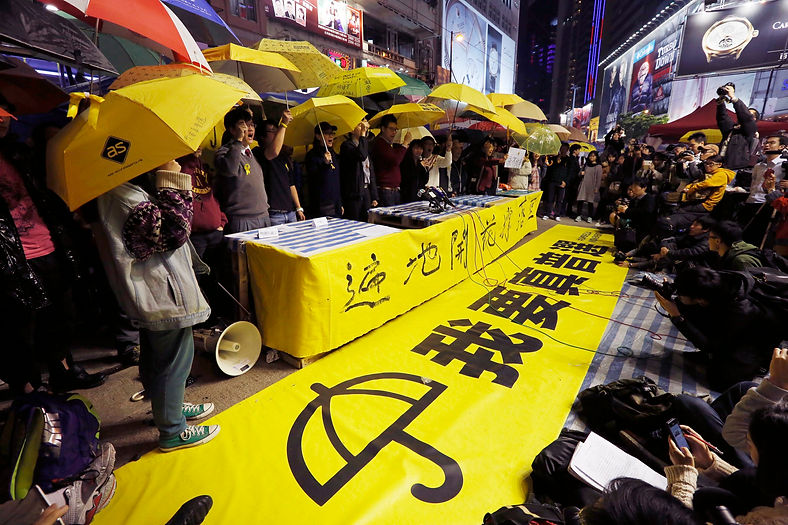
One of the main reason that led to the 2014 Umbrella Movement wildly popular, back in 2014, because of the power of Social Networking Sites (SNSs). The reason it was called the Umbrella Movement by media because the protesters used umbrellas to protect themselves from the police’s pepper spray and tear gas. It was happened because the Chinese government’s decision to block the democrats from being elected as the Hong Kong chief executive in the scheduled 2017 universal suffrage.
The article focuses on the engine that fueled the Umbrella Movement, the SNSs; which is questionable. In fact, the German sociologist, Jürgen Habermas, and his famous theory, the public sphere, does a good job explaining abstractly on what could SNSs potentially power and what not to a social movement. SNSs are the ‘new wine in old bottle’ of public sphere because of its ‘free-cost’ democracy. On the other hand, it also fails in distributing credible sources make social movements like Umbrella Movement questionable.
The decline of previous forms of public sphere
The Public Sphere
Transparent and accessible information has always been the core of public sphere. This means information are taken under a form as an arena, and enjoying partisan forces that are dedicated to the rational debate to create better, more ideal arguments. They are easily accessible to entry and open to inspection for anybody. (Webster 2002)
It is also called as The Bourgeois Public Sphere as it allows private people come together in the public, the early, well-known form. Soon Public Sphere were regulated as a ruling method over public authorities.
The French Salon
Previous technologies development has brought up its democratic and mobilizing power. Traditional media like the like of newspaper press and public television have been an integral part in the creation of a national public sphere. They all try to provide the basis of shared concerns, commons states and cultural turns (Iosifidis 2011) However, the idea of ‘public sphere’ isn’t not ideal as it seems to be declined with the general development of managing and packing information.
With skepticism of public funded technologies and organization, like the like of public service broadcasting can be regarded as tools of government and combining with information management, which is also fundamental for today’s government, public opinions are unsurprisingly manipulated as an attempt for social control. This has questioned whether these technologies still have its democratic and mobilizing power (Webster 2002)
John Keane has an idea to returning to public service broadcasting only if fully state supported media tend to speak with a more homogenise terms, more together tone of voice. Yet this is feasible in today’s globalized and differentiated world where there is enormous and suspicion of state-organized broadcasting. Keane tries to emphasizes and evokes a concept of civil society that could be as plural, complex and dynamic, yet it is not associated with the states (Webster 2002)
John Keane talks about how networks can still be autonomously sustained while there is multiplicity of ways in which people may come together to debate, argue and inform one another. This is when the Internet, or specifically the social networking sites (SNSs) helps extending the idea of transparent and accessible information, which is a brief idea of democracy, comes in as it helps extending the availability of public sphere.

Free-cost democracy
Today’s internet can also create public spheres for various topics, including political intervention. And with the ability of the internet, the realm of participation is expansive. This leads to some of the comparison of today’s internet as more of a ‘new wine in old bottle’ type of ‘public sphere’; a ‘digital sphere’. (Iosfidiss 2011) The new appearance of Web 2.0 allows to do such things with online forums, social spaces or SNSs in general differ substantially, compared to traditional media. They simply allow more interactivity and many-to-many communication, rather than one-to-many, allow individuals to exchange their own perspectives and their own knowledge, critical points of views.
According to Iosfidis, in online contexts, anyone can take the role of speaker with practically no cost, combining with the multiple sources of news and freeing both the communication and information from any sort of system of control. Anybody can be a ‘publisher’ or ‘producer’, and can expand to infinite length. In theory, or at least to Habermas, this ‘digital sphere’ is ideal as it is free and decentralized space that easily create the conditions for ideal speech and enhance the ability to voice one’s opinion and organize collective action, the ideal notion of democracy that is talked in Habermas’s theory.
Up to 87% in the 18-29 age group of use social media frequently. Facebook is the dominant social media site used by Hong Kong youth, particularly during the Umbrella Movement. Many youngsters switched profile pictures on Facebook to yellow ribbons or umbrellas to show their support for the movement
SNSs is conceived as having a democratic capacity in forester alternative discourses and empowering marginalized groups. The cost for SNS users to set up a site or to become a node in the network is much lower. In the conventional form, it also usually requires leadership and discipline, loose groups are usually not included in massive social actions because the cost of coordinating them and putting them within bounds is high (N. Lee, K. So & Leung 2015). Social media, however, can reduce the costs of coordinating undisciplined groups and facilitate diverse marginalized groups to join hands for a common cause. More importantly, social media helps to create ‘shared awareness’, understand the situation at hand and understand that everyone else does, which is a crucial form of coordination for collective action. SNS users are no longer passive consumers and spectators; they have become creators and primary subjects, and in this sense, the Internet democratizes. Anybody can join in, form groups and participate (N. Lee, K. So & Leung 2015)
During the Umbrella Movement, with the reduction of satisfaction with the HKSAR government, the Hong Kong police and the Chinese central government, the use of social media increased supporting the Occupy Movement. In this sense, democratization of SNSs has clearly the existence of a counter-public sphere operating side-by-side with the dominant public sphere represented by the dominant mass media, which resulting Umbrella Movement. The mass media public sphere,
according to Habermas, had changed the culture-debating public into the culture-consuming public, and the essence of critical-rational political discussions in the public sphere was lost. (N. Lee, K. So & Leung 2015). Furthermore, SNSs seemingly reaffirms the ideal of John Keane as a more ‘homogenise’ terms, a together tone of voice, but it is existed in a newer form of public sphere, not Habermas’s original one.
Questionable news channel
However, It also meets its limitation just like the original public sphere. One of the qualification that makes a public sphere is it should be constantly surround with ‘weighty’ debates and discussion. (Webster 2002) Much online discussion is characterized as bad-tempered. These ‘open discussion’ of the Internet can easily turn into chaos, thereby following no structured conversation. Forms of extensive dialogue and critical discussion, which is crucial to the pubic sphere, appear doubtful on these online forums, as it could look more anarchic than democratic forms of participation (Iosfidis 2011)
19% of respondents named Facebook as the major source from which they most frequently got political news. Facebook ranked third after the mainstream media Television Broadcasts Ltd. (TVB) and Apple Daily, which, respectively, 67% and 33% of respondents named as the source for political news.
Additionally, it is also argued that the content on Internet is also highly partisan and this should not be ruled out for SNSs. While internet remains as a space, a sphere for discussion, the internet remains more of a distribution medium for many of news sources. The substantial amount of content such as blogs are created makes it difficult to trace credible blogs. Additionally, online debate is also easily polarized as there is generally a lack of listening to others. Although internet companies invest in this medium, the investment has tended to be in technology and not in journalists (Iosfidis 2011)
Respondents were asked if they obtained political news from Facebook, which was the most important social media platform during the Umbrella Movement; 19% of respondents named Facebook as the major source from which they most frequently got political news. Facebook ranked third after the mainstream media Television Broadcasts Ltd. (TVB) and Apple Daily, which, respectively, 67% and 33% of respondents named as the source for political news.
The findings indicate that the use of social media had a positive and significant, albeit small, contribution to people’s support for the social movement. Most people today still use mass media as their major source of news and information, and people’s political orientation is influential in determining their support for a social movement (N. Lee, K. So & Leung 2015) While some regarded the criticism of Habermas on quality of debates, as ‘over-sombre’ and incapable of what is more essential to more basic needs, matters such as emotion and feelings, Habermas’s concern also on point as these sources from SNSs are not credible and even partisan (Webster 2002). And with the Umbrella Movement, powered by SNSs, this leads to the movement in a questionable position as it also meets the limitation, to maintain the ideal of public sphere.
An alternative public sphere
There are certain hopes for SNSs and the Internet in general that could complete the ideal of public sphere. Yet, it is still at the end still struggle to do so. The appearance of Web 2.0, which are SNSs particularly, helps release the ideal of democracy that previous forms of public sphere could not allow to do so. The free-cost democracy allows SNSs creating an alternative public sphere, an optional public sphere, comparing with the usual, traditional method that helps forming a together voice and the rise of Umbrella Movement shows just that perfectly. However, the nature of SNSs as it is simply more of distributing medium, with unreliable, questionable news sources, also begs questions whether the movement is even justified. The engine behind those whose join the movement are simply partisan and not trustworthy enough. Yet, it is sure that SNSs will be used many more in future social movements as they don’t take really that much efforts to form social nodes either.

OPINION
TODAY'S UPDATE
In a wake of recent data leaks from Facebook and questionable last US presidential election, frankly, we are oblivious with the ability of Web 2.0. In addition, with the birth of Social Media, the versatility of ICTs, our identity are increasingly accessible to be expose.
Data is gradually becoming a strong concern for many. Privacy is one thing, but there is another looming question whether "Digital Sphere" would be categorized as a public sphere. Simply, users are skeptical if their news sources were credible and if the topic were manipulated third parties. The Umbrella Movement was the first example of this issue. Lastly, for the case of Social Media, it seems like Data and Privacy is the cost, in exchange of democracy.

References
Iosifidis, P. (2011) ‘THE PUBLIC SPHERE, SOCIAL NETWORKS AND PUBLIC SERVICE MEDIA’, Information, Communication & Society, 14(5), pp. 619–637. doi: 10.1080/1369118x.2010.514356.
Lee, P.S.N., So, C.Y.K. and Leung, L. (2015) ‘Social media and umbrella movement: Insurgent public sphere in formation’, Chinese Journal of Communication, 8(4), pp. 356–375. doi: 10.1080/17544750.2015.1088874
Webster, F 2002, Theories of the Information society, 1st edn, Routledge, London.